Consent & Causation

In criminal law, the doctrines surrounding sexual consent and proximate causation are both thought to reflect conclusions about individual autonomy. But these doctrines diverge in striking ways. In rape law, the choice to consent to sex is deemed sufficiently autonomous even when made in response to threats or coercion, when induced by fraudulent misrepresentations, or when produced by mental impairment. By contrast, the doctrine of proximate causation holds that a choice made in response to force, coercion, fraud, or mental impairment is insufficiently autonomous, and therefore an individual is not morally responsible for any resulting consequences. This divergence invites a crucial question: Does the law of proximate causation capture something important about individual autonomy that has been overlooked in the law of sexual consent? After all, sexual consent frequently plays a causal role in normatively desirable sexual encounters. Yet the structure of U.S. rape law elides any inquiry into causation. Might rape law be improved—might it better protect individual autonomy—by demanding that sexual consent be a proximate cause of sex itself?

This Article is the first to raise this question and undertake this inquiry. By juxtaposing consent and causation in criminal jurisprudence, it reveals an inconsistency in the understandings of autonomy that motivate those doctrines, shedding new light on longstanding criticisms of rape law. This Article then makes a preliminary case for reforming rape law by recasting sexual consent as a matter of proximate causation. It offers three grounds for doing so: First, philosophical accounts of sexual autonomy require an individual to be able to control the character and circumstances of sexual contact, a requirement that is only vindicated when consent causally contributes to sexual activity. Second, the best understanding of consent’s exonerating role in sex is that consent alters another person’s reasons for acting, a function that can only occur when consent causally motivates sexual behavior. Lastly, the leading accounts of when sex is normatively desirable rest on a conception of mutuality—that is, responsiveness to the other person’s active consent. In short, this Article advances the novel claim that sexual activity is normatively desirable when it occurs because it is consented to, not merely whenever it is consented to.

The Article concludes by considering how rape laws may be reformed to leverage the normative insights just uncovered. It first examines the recent revisions to the sexual assault provisions of the Model Penal Code adopted by the American Law Institute in 2022. Those revisions, for the first time, included both requirements of causation and requirements of nonconsent. But the Model Penal Code’s revisions hew too closely to traditional rape laws, ultimately failing to capture the broad spectrum of normatively undesirable sex that warrants criminalization. The Article instead reconfigures rape as primarily a result crime, prohibiting specific wrongful means of causing sexual intercourse and exonerating sex when consent is the proximate cause. A rape law structured around the causes of sexual intercourse may best capture our normative intuitions about why and when consent matters.

Introduction

Consent is the primary legal mechanism used by the criminal law—rape law, in particular—to safeguard sexual autonomy.1.See, e.g., Stuart P. Green, Criminalizing Sex: A Unified Liberal Theory 25 (2020); see also Alan Wertheimer, Consent to Sexual Relations 31 (2003) (“In effect, autonomy refers to the value that is to be protected, whereas consent refers to the means for protecting and promoting that value: we protect a person’s autonomy by prohibiting actions to which she does not consent and empowering her to engage in actions to which she does consent.” (emphasis omitted)); Luis E. Chiesa, Solving the Riddle of Rape-by-Deception, 35 Yale L. & Pol’y Rev. 407, 419 (2017) (“[C]onsent is the tool that law most commonly deploys in order to operationalize conceptions of freedom and autonomy.”); Patricia J. Falk, Rape by Drugs: A Statutory Overview and Proposals for Reform, 44 Ariz. L. Rev. 131, 187 (2002) (“As many commentators have observed, the central value protected by sexual offense provisions is sexual autonomy or sexual integrity, the violation of which represents a unique, not readily comparable, type of harm to the victim.” (footnotes omitted)).Show More However, American rape law has long been criticized for advancing a conception of consent that survives common means of subverting autonomy.2.See, e.g., Patricia J. Falk, Rape by Fraud and Rape by Coercion, 64 Brook. L. Rev. 39, 162–68, 173–77 (1998) (detailing scholarly criticisms of rape law’s treatment of sexual fraud and sexual coercion); see also Stephen J. Schulhofer, Unwanted Sex: The Culture of Intimidation and the Failure of Law 114–36 (1998) (critiquing rape law’s treatment of coercive situations as consensual).Show More Judges and juries have found valid consent to sexual intercourse in the face of deadly threats,3.See infra Subsection I.C.1.Show More psychological coercion,4.See infra Subsection I.C.1.Show More material fraud,5.See infra Subsection I.C.2.Show More intoxication,6.Coley v. State, 616 So. 2d 1017, 1023 (Fla. Dist. Ct. App. 1993) (“The prevailing view is that voluntary consumption of drugs or alcohol does not, without more, render consent involuntary.”); State v. Sherrill, No. 71,253, 1995 WL 18253106, at *3–4 (Kan. Ct. App. June 9, 1995) (finding insufficient evidence that the complainant could not consent despite her testimony that “she had consumed a considerable amount of alcoholic liquor”). See generally infra Subsection I.C.3.Show More and mental impairment.7.See infra Subsection I.C.3.Show More As Catharine MacKinnon has documented, “Consent as a legal standard in the law of sexual assault commonly exonerates sexual interactions that are one-sided, nonmutual, unwanted, nonvoluntary, nonreciprocal, constrained, compelled, and coerced.”8.Catharine A. MacKinnon, Rape Redefined, 10 Harv. L. & Pol’y Rev. 431, 443 (2016).Show More

In another corner of criminal law, threats, coercion, fraud, intoxication, and impairment are thought to so significantly undermine autonomy that a person affected by them is deemed irresponsible—both morally and legally—for resulting consequences.9.See infra Section II.B.Show More This is the law of proximate causation. Under a causation analysis, the criminal law rigorously interrogates whether a person’s actions are sufficiently autonomous to render that person blameworthy for consequences that follow.10 10.See, e.g., Eric A. Johnson, Trust and the Limits of Trust: Rethinking the Doctrine of Novus Actus Interveniens, 2025 U. Ill. L. Rev. 743, 751–55; Guyora Binder & Luis Chiesa, The Puzzle of Inciting Suicide, 56 Am. Crim. L. Rev. 65, 99 (2019).Show More When a person’s actions are not autonomous, it is often because their autonomy was infringed by some earlier-in-time blameworthy conduct by another, who now carries moral and legal responsibility.11 11.See Michael S. Moore, The Metaphysics of Causal Intervention, 88 Calif. L. Rev. 827, 836 (2000) (“[I]f the defendant coercively supplies the motive for the intervenor’s behavior, then that behavior does not break the causal chain between defendant’s action and the harm.”).Show More

Juxtaposing consent and causation thus reveals a tension in the criminal law’s depictions of individual autonomy—a tension that goes to the heart of what it means to bear moral and legal responsibility for sex. When the law asks whether someone is responsible for an act of sexual intercourse, it is best understood as asking a question about causation. After all, both legal and moral responsibility for an event typically follow from an inquiry into who caused the event to occur.12 12.See Binder & Chiesa, supra note 10, at 70 (explaining that causation in criminal law is “little more than a normative attribution of responsibility for a result”).Show More But when the law concludes that someone consented to an act of sexual intercourse, it also seemingly asserts something about that individual’s moral and legal responsibility. An individual who consents to sex is expected to bear the consequences of that act of consent, for better or worse, without complaint.13 13.See, e.g., Heidi M. Hurd, The Moral Magic of Consent, 2 Legal Theory 121, 123 (1996) (“[C]onsent defeats any rights on the part of others (including the person consenting) that the actor not do the wrong act.”).Show More Moreover, because consent operates to absolve other parties from legal responsibility for a sexual act, consent seemingly intervenes in the attribution of responsibility.14 14.See id. at 124 (“Whether it functions as a ‘moral transformative’ or as a ‘stained permission,’ consent derives its normative power from the fact that it alters the obligations and permissions that collectively determine the rightness of others’ actions.”).Show More

These conclusions about moral and legal responsibility for sex are unproblematic when sex goes right. In paradigmatic consensual sexual interactions, sex presumptively happens because there was a prior act of consent. Thus, the law’s conclusions about causal responsibility and its conclusions about consensual responsibility should align.

But when sex goes wrong—when consent is tainted by external factors, including force, coercion, fraud, intoxication, and mental impairment—the criminal law’s causal conclusions diverge sharply from its conclusions about the validity of sexual consent. Consider the situation where sexual consent is fraudulently induced, such as when a doctor tells a patient that sexual intercourse is a necessary component of medical treatment.15 15.See, e.g., Boro v. Superior Ct., 210 Cal. Rptr. 122, 123 (Ct. App. 1985) (defendant posed as a doctor and convinced the victim that she needed to have sex with an anonymous donor in order to treat “a dangerous, highly infectious and perhaps fatal disease”).Show More The criminal law’s causation doctrine would hold that the doctor, rather than the patient, should bear moral and legal responsibility for causing the sex.16 16.See infra Subsection II.C.2.Show More But the criminal law’s consent doctrine would hold that the consent is valid and enforceable,17 17.See infra Subsection I.C.2.Show More rendering the sex noncriminal, and leaving the victim to bear the weight of any experienced harm.

Viewing sexual consent as one act in a chain of actions that results in sexual intercourse reveals a limitation in the structure of U.S. rape law. The typical rape statute in the United States makes sexual nonconsent an attendant circumstance—an extraneous fact that is not causally connected to the essential conduct with which the defendant stands accused.18 18.The traditional common law definition of rape was “carnal knowledge of a woman forcibly and against her will.” 4 William Blackstone, Commentaries *210. In this formulation, still relevant in roughly half of U.S. states, MacKinnon, supra note 8, at 437 & n.26, the element that the intercourse be nonconsensual (or “against her will”) is an attendant circumstance, see, e.g., Susan Estrich, Rape, 95 Yale L.J. 1087, 1121 n.101 (1986). Attendant circumstances “refer to the objective situation that the law requires to exist, in addition to the defendant’s act or any results that the act may cause.” Model Penal Code § 5.01 cmt. at 301 n.9 (A.L.I., Official Draft and Revised Comments 1985).Show More Because of this structural choice, sexual consent renders sexual intercourse noncriminal whenever it is present. External factors that bear on moral responsibility—force, coercion, fraud, and impairment among them—have little doctrinal significance in defining a particular sexual interaction as rape because causation is left out of the picture.19 19.See infra Section I.C.Show More

This revelation invites two further questions, one normative and one doctrinal. Normatively, ought we demand that consent play a causal role in sexual interactions if it is to exonerate them? Stated differently, is the mere presence of legally valid consent morally transformative? Or is sex normatively desirable only when legally valid consent causes subsequent sexual acts? Assigning a causal role to sexual consent seemingly ensures that criminality maps onto our ordinary intuitions about who bears responsibility for a result. If rape law—like criminal law more generally—seeks to track moral responsibility (hence blameworthiness),20 20.Although there are of course varied justifications for the criminal law, many leading theorists agree that blameworthiness is or ought to be the centerpiece of our criminal system. See, e.g., Douglas Husak, “Broad” Culpability and the Retributivist Dream, 9 Ohio St. J. Crim. L. 449, 449 (2012); Michael Moore, Placing Blame: A General Theory of the Criminal Law 153–54 (1997); Larry Alexander & Kimberly Kessler Ferzan with Stephen Morse, Crime and Culpability: A Theory of Criminal Law 66–67 (2009).Show More there are at least provisional arguments that causation should be required.21 21.See infra Section III.A.Show More

Doctrinally, contrasting consent and causation invites inquiry into how to structure rape statutes to ensure that consent is causally efficacious. I have been down this road once before, postulating that a rape law modeled on human trafficking laws might profitably incorporate a causation requirement.22 22.Ben A. McJunkin, Rape as Indignity, 109 Corn. L. Rev. 385, 447 (2024).Show More The recent reforms to the Model Penal Code also hint in this direction. Under the model language adopted at the 2022 annual meeting, at least some sexual assaults would require that sexual intercourse be caused by the defendant’s use of force, deception, or extortion (and therefore not caused by the complainant’s consent).23 23.See Model Penal Code §§ 213.1–213.2, 213.4–213.5 (A.L.I., Tentative Draft No. 6, 2022).Show More However, the model language ultimately continues the trend of centering the presence and validity of consent, rather than its causal role in the encounter. Taking consent’s causal role in sexual relations seriously would thus require revisions to rape law that go beyond the new Model Penal Code.

This Article proceeds in three Parts. Part I examines the current role of consent in U.S. rape law and its ostensible commitment to protecting individual sexual autonomy. This Part catalogues how consent has been found to be present and valid even in the face of threats, coercion, fraud, or mental impairment. Part II examines the doctrines of proximate and intervening causation, exploring these doctrines’ philosophical grounding in individual autonomy. In contrast to Part I, this Part catalogues how threats, coercion, fraud, and mental impairment interrupt causation precisely because they so impair autonomy as to absolve individuals of moral and legal responsibility. In light of this juxtaposition, Part III constructs a normative argument that a proper understanding of autonomy requires that consent play a causal role in sexual intercourse if intercourse is to be normatively desirable. It then explores the consequences of this argument for rape law reformers: rape should not be understood as sex in the absence of consent, but rather as causing sex through specified, prohibited means other than consent, allowing sexual consent’s doctrinal role to track its normative one.

  1.  See, e.g., Stuart P. Green, Criminalizing Sex: A Unified Liberal Theory 25 (2020); see also Alan Wertheimer, Consent to Sexual Relations 31 (2003) (“In effect, autonomy refers to the value that is to be protected, whereas consent refers to the means for protecting and promoting that value: we protect a person’s autonomy by prohibiting actions to which she does not consent and empowering her to engage in actions to which she does consent.” (emphasis omitted)); Luis E. Chiesa, Solving the Riddle of Rape-by-Deception, 35 Yale L. & Pol’y Rev. 407, 419 (2017) (“[C]onsent is the tool that law most commonly deploys in order to operationalize conceptions of freedom and autonomy.”); Patricia J. Falk, Rape by Drugs: A Statutory Overview and Proposals for Reform, 44 Ariz. L. Rev. 131, 187 (2002) (“As many commentators have observed, the central value protected by sexual offense provisions is sexual autonomy or sexual integrity, the violation of which represents a unique, not readily comparable, type of harm to the victim.” (footnotes omitted)).
  2.  See, e.g., Patricia J. Falk, Rape by Fraud and Rape by Coercion, 64 Brook. L. Rev. 39, 162–68, 173–77 (1998) (detailing scholarly criticisms of rape law’s treatment of sexual fraud and sexual coercion); see also Stephen J. Schulhofer, Unwanted Sex: The Culture of Intimidation and the Failure of Law 114–36 (1998) (critiquing rape law’s treatment of coercive situations as consensual).
  3.  See infra Subsection I.C.1.
  4.  See infra Subsection I.C.1.
  5.  See infra Subsection I.C.2.
  6.  Coley v. State, 616 So. 2d 1017, 1023 (Fla. Dist. Ct. App. 1993) (“The prevailing view is that voluntary consumption of drugs or alcohol does not, without more, render consent involuntary.”); State v. Sherrill, No. 71,253, 1995 WL 18253106, at *3–4 (Kan. Ct. App. June 9, 1995) (finding insufficient evidence that the complainant could not consent despite her testimony that “she had consumed a considerable amount of alcoholic liquor”). See generally infra Subsection I.C.3.
  7.  See infra Subsection I.C.3.
  8.  Catharine A. MacKinnon, Rape Redefined, 10 Harv. L. & Pol’y Rev. 431, 443 (2016).
  9.  See infra Section II.B.
  10.  See, e.g., Eric A. Johnson, Trust and the Limits of Trust: Rethinking the Doctrine of Novus Actus Interveniens, 2025 U. Ill. L. Rev. 743, 751–55; Guyora Binder & Luis Chiesa, The Puzzle of Inciting Suicide, 56 Am. Crim. L. Rev. 65, 99 (2019).
  11.  See Michael S. Moore, The Metaphysics of Causal Intervention, 88 Calif. L. Rev. 827, 836 (2000) (“[I]f the defendant coercively supplies the motive for the intervenor’s behavior, then that behavior does not break the causal chain between defendant’s action and the harm.”).
  12.  See Binder & Chiesa, supra note 10, at 70 (explaining that causation in criminal law is “little more than a normative attribution of responsibility for a result”).
  13.  See, e.g., Heidi M. Hurd, The Moral Magic of Consent, 2 Legal Theory 121, 123 (1996) (“[C]onsent defeats any rights on the part of others (including the person consenting) that the actor not do the wrong act.”).
  14.  See id. at 124 (“Whether it functions as a ‘moral transformative’ or as a ‘stained permission,’ consent derives its normative power from the fact that it alters the obligations and permissions that collectively determine the rightness of others’ actions.”).
  15.  See, e.g., Boro v. Superior Ct., 210 Cal. Rptr. 122, 123 (Ct. App. 1985) (defendant posed as a doctor and convinced the victim that she needed to have sex with an anonymous donor in order to treat “a dangerous, highly infectious and perhaps fatal disease”).
  16.  See infra Subsection II.C.2.
  17.  See infra Subsection I.C.2.
  18.  The traditional common law definition of rape was “carnal knowledge of a woman forcibly and against her will.” 4 William Blackstone, Commentaries *210. In this formulation, still relevant in roughly half of U.S. states, MacKinnon, supra note 8, at 437 & n.26, the element that the intercourse be nonconsensual (or “against her will”) is an attendant circumstance, see, e.g., Susan Estrich, Rape, 95 Yale L.J. 1087, 1121 n.101 (1986). Attendant circumstances “refer to the objective situation that the law requires to exist, in addition to the defendant’s act or any results that the act may cause.” Model Penal Code § 5.01 cmt. at 301 n.9 (A.L.I., Official Draft and Revised Comments 1985).
  19.  See infra Section I.C.
  20.  Although there are of course varied justifications for the criminal law, many leading theorists agree that blameworthiness is or ought to be the centerpiece of our criminal system. See, e.g., Douglas Husak, “Broad” Culpability and the Retributivist Dream, 9 Ohio St. J. Crim. L. 449, 449 (2012); Michael Moore, Placing Blame: A General Theory of the Criminal Law 153–54 (1997); Larry Alexander & Kimberly Kessler Ferzan with Stephen Morse, Crime and Culpability: A Theory of Criminal Law 66–67 (2009).
  21.  See infra Section III.A.
  22.  Ben A. McJunkin, Rape as Indignity, 109 Corn. L. Rev. 385, 447 (2024).
  23.  See Model Penal Code §§ 213.1–213.2, 213.4–213.5 (A.L.I., Tentative Draft No. 6, 2022).

Interpretive Lawmaking

For nearly 100 years, prevailing American legal thought has rejected the idea that there can be unwritten bodies of law that judges ascertain and apply just as they do written law. Instead, the story goes, the only preexisting sets of legal rules come from written texts; all other rules—at common law, in equity, or in filling gaps in statutory or constitutional text—are necessarily made by judges. So, when a written text fails to provide a legal rule, courts have the power to make policy decisions and create one, subject to some limitations such as the Due Process Clause.

But the Founders understood judges to be capable of resolving disputes by only finding law—a belief that persisted into the early twentieth century. Not only did judges lack the authority to make law at common law or in equity, but they also lacked authority to make law in applying written text—even when traditional methods of finding and applying written law provided no answer and even if Congress intended to delegate lawmaking power. What’s more, the judicial power granted in Article III was not originally understood to have included a freestanding lawmaking power. And because it is possible for judges to find law, that original understanding might constrain the judiciary today. To be sure, it is often difficult to know where interpretation and application end and lawmaking begins. And the Founders’ conception of the judicial role might not be binding or might have been altered by nearly a century’s practice. But judges, especially originalist judges, should seriously confront the fact that, as an original matter, the Constitution granted judges no lawmaking power.

This Article also explores how several current judicial doctrines might change if courts refused to make law in applying written text. For example, Article III could offer its own prohibition against vague statutes—subject to different requirements and remedies than the conventional due process-based vagueness doctrine. A return to the original understanding of the judicial power would cast doubt on the judicial practices of interstitial lawmaking and of making law when applying so-called “common law statutes.” And Erie guesses might raise Article III concerns if the relevant state court is authorized to make law (in which case federal courts predicting such a state court would be impermissibly lawmaking). Stare decisis considerations might counsel caution in some areas. But judges should also approach the constitutional problems and doctrinal inconsistencies caused by uncritical judicial lawmaking with clear eyes.

Introduction

Justice Oliver Wendell Holmes, Jr., derided the idea of preexisting unwritten law as belief in a “brooding omnipresence in the sky.”1.See S. Pac. Co. v. Jensen, 244 U.S. 205, 222 (1917) (Holmes, J., dissenting).Show MoreHe even criticized Justice Story for being “dominat[ed]” by such a fanciful idea in Swift v. Tyson.2.41 U.S. (16 Pet.) 1 (1842), overruled by Erie R.R. Co. v. Tompkins, 304 U.S. 64 (1938); Black & White Taxicab & Transfer Co. v. Brown & Yellow Taxicab & Transfer Co., 276 U.S. 518, 533–35 (1928) (Holmes, J., dissenting).Show MoreShortly thereafter, the Supreme Court declared the idea a “fallacy” and disclaimed the existence of any “transcendental body of law outside of any particular State but obligatory within it unless and until changed by statute.”3.Erie, 304 U.S. at 79 (quoting Black & White Taxicab, 276 U.S. at 533 (Holmes, J., dissenting)).Show MoreIn the modern era, even Justice Scalia, who was otherwise considered a historical formalist, considered the idea “naive.”4.James B. Beam Distilling Co. v. Georgia, 501 U.S. 529, 549 (1991) (Scalia, J., concurring in the judgment); Stephanos Bibas, Blakely’s Federal Aftermath, 16 Fed. Sent’g Rep. 333, 341–42 (2004) (noting “Justice Scalia’s historical, formalist ideal”). Justice Scalia distinguished what the lawmaking legislators do by recharacterizing judicial lawfinding as a case-by-case lawmaking in which judges “discern[] what the law is, rather than decreeing what it is today changed to, or what it will tomorrow be.” James B. Beam, 501 U.S. at 549; see also id. at 546 (White, J., concurring in the judgment) (arguing that Justice Scalia’s proposed distinction does not work and relies on “citizens who are naive enough to believe” that lawfinding is possible). But that move does not completely avoid the problem because lawfinding at the Founding was not considered to be lawmaking at all. See infra note 128.Show MoreIf it is true that judges routinely make law, then the basis for the Constitution’s protections of judicial independence, such as life tenure, becomes unclear, as they were premised on the idea that judges would find law. And if judges are not in fact so constrained, why should those protections bind today?

But the tides are turning—or returning. Recent scholarship has defended the prevailing conception at the Founding that judges can find law—either as expressed in written text or as existing as authoritative unwritten law.5.See, e.g., Stephen E. Sachs, Finding Law, 107 Calif. L. Rev. 527, 529 (2019) [hereinafter Sachs, Finding Law]. To be sure, seeds of dissent have been around for much longer. See William A. Fletcher, The General Common Law and Section 34 of the Judiciary Act of 1789: The Example of Marine Insurance, 97 Harv. L. Rev. 1513, 1514–15 (1984); Caleb Nelson, A Critical Guide to Erie Railroad Co. v. Tompkins, 54 Wm. & Mary L. Rev. 921, 924–37 (2013) [hereinafter Nelson, Critical Guide].Show MoreOne commentator has even argued that the judicial power given to federal courts in Article III does not include the authority to make common law.6.See Micah S. Quigley, Article III Lawmaking, 30 Geo. Mason L. Rev. 279, 302–05 (2022).Show MoreAnd a recent article advances the argument that the law does not necessarily run out, which means that a judge could only find law.7.See Charles F. Capps, Does the Law Ever Run Out?, 100 Notre Dame L. Rev. (forthcoming 2025) (manuscript at 11–12), https://papers.ssrn.com/sol3/papers.cfm?abstract_‌id=4908863 [https://perma.cc/97YH-FDPP].Show MoreFormalist judges have introduced some of these underlying theories in various contexts.8.See, e.g., Lester v. United States, 921 F.3d 1306, 1312–13 (11th Cir. 2019) (Pryor, J., statement respecting the denial of rehearing en banc) (asserting that judges find law in the context of retroactivity in collateral proceedings).Show MoreBut to date, little attention has been paid to legal interpretation in a post-realist legal order.9.One notable recent exception is Professor Charles Tyler. See Charles W. Tyler, Common Law Statutes, 99 Notre Dame L. Rev. 669, 679–84 (2023). But he offers other reasons for using general law in interpretation, see id. at 684–92, and avoids answering the question whether Article III requires it, id. at 685 & n.92.Show MoreThis Article fills that void.

Historically, courts distinguished between interpreting and applying law—which were permissible judicial functions—and making law when neither statute nor unwritten law provided a legal rule—which was an impermissible legislative function.10 10.See, e.g., Gelston v. Hoyt, 16 U.S. (3 Wheat.) 246, 309 (1818).Show MoreAlthough the line was not always easy to draw, courts tried to thread the needle and considered themselves to be applying only preexisting law, possible instances of judicial lawmaking notwithstanding. It was in this legal context that Article III was drafted and ratified. The judicial power referenced in Article III was not understood to contain a substantive lawmaking power—even when no law provided an applicable rule.11 11.See infra Subsection II.A.3.Show MoreAnd because judges found rather than made law, they plausibly needed to be independent from political interests that would seek to influence them to create new law outside the legislative process.

This conclusion has obvious relevance for cases involving unwritten law, but the Founding generation similarly understood the judicial power to be so limited in cases involving written law. When a case turned on a question of written law, courts first looked to the text—in the light of the common law and other legal customs—to find the relevant legal rule. If this textual inquiry did not provide an answer, courts could apply a rule of unwritten law (if there was one) or state law in some instances. And if there was no applicable unwritten- or state-law rule, courts considered themselves bound to simply declare that there was no legal rule and use default rules or burdens of proof to resolve the parties’ dispute.12 12.See infra Subsection II.A.3.Show MoreIn a way, the lack of authority would have incentivized judges to find all the law they could in recognized sources.

Then arrived the legal realist movement, which was reflected in Erie Railroad Co. v. Tompkins. Erie declared three principles, only one of which I challenge here. First, it explained that in cases arising from diversity jurisdiction, state substantive law applied under both the Rules of Decision Act and the Constitution.13 13.Erie R.R. Co. v. Tompkins, 304 U.S. 64, 78 (1938); Nelson, Critical Guide, supra note 5, at 951.Show MoreNothing in this Article undermines that conclusion.14 14.For an argument that this conclusion did not support the holding in Erie, see Nelson, Critical Guide, supra note 5, at 951–56, 959.Show MoreSecond, in a departure from the first nearly 150 years of American jurisprudence, Erie stated that there was no American general common law.15 15.Erie, 304 U.S. at 78–79. For an argument that such general law demonstrably existed, see Fletcher, supra note 5, at 1514–21. For an argument that it persists post-Erie, see Caleb Nelson, The Persistence of General Law, 106 Colum. L. Rev. 503, 547–48, 548 n.216 (2006) [hereinafter Nelson, Persistence].Show MoreAgain, nothing here requires jettisoning this conclusion. If there is a general common law, then it might be within the judicial power to find and apply it; if there is no such law, judges would still have been considered bound to find law, albeit from other sources. Third, Erie asserted that there was no such thing as unwritten law—when judges pronounced a legal rule, they were in fact making that rule as much as a legislature would make a rule through a statute.16 16.Erie, 304 U.S. at 79.Show MoreOnly this part of Erie is implicated here. Erie was incorrect to conclude that finding law is impossible. Even further, by not granting the federal judiciary any lawmaking power, the Constitution necessarily envisioned a judiciary confined to finding law. So, to reiterate, nothing I say here implicates Erie’s conclusions that state substantive law governs in diversity cases or that there is no American general common law. Rather, my target is Erie’s conclusion that judicial lawmaking is inevitable. Not only is that conclusion mistaken, but Article III’s grant of judicial power contemplated the opposite: a judiciary that only found law.

Part I explains that finding law is indeed possible. The notion that finding law is possible is a prerequisite to the argument that the Constitution put into place a system that required courts to exclusively find law. If finding law were not possible, the conceptions of judicial power held by the Framers and ratifiers of the Constitution would have little import, even under originalist theories. Part I borrows on recent scholarship by Steve Sachs, Micah Quigley, and Allan Beever, all of whom defend in different ways the possibility of finding unwritten law, and all of whom tie those theories to Founding-era legal thought.

Part II first argues that the judicial power granted to the federal judiciary in Article III did not include a freestanding lawmaking power. The Framers and ratifiers considered judges bound to find and apply preexisting law—whether written or unwritten. And that conception informs the phrase “judicial Power” in Article III. Assuming our government is one of enumerated powers, the fact that the judicial power did not include a freestanding lawmaking power entails that judges were granted only the power to find law, not make it.

Part II also responds to two forceful counterarguments that stand in the way. First, the Founding generation understood courts’ power to make procedural law as consistent with the judicial role. And if Article III’s judicial power allows procedural lawmaking, the argument goes, surely it allowed judges to make substantive law. Second, sometimes—explicitly or implicitly—Congress delegated its Article I lawmaking power to the judiciary. When Congress attempted to do so, an objector might argue, judges were constitutionally obligated to honor Congress’s intent and make law. Regardless of whether this potential for delegated lawmaking justified judicial lawmaking in areas without such delegation, Article III’s judicial power surely allowed judges to make law when Congress delegated that power to them.

But both counterarguments come up short. Federal courts’ limited authority to make “procedural law” did not justify a freestanding substantive lawmaking power. The source of the federal judiciary’s procedural lawmaking power is uncertain. It might be an incidental judicial power to the case-deciding judicial power (that is, the judicial power granted in Article III). In other words, as a historical matter, the case-deciding judicial power necessarily entailed a procedural-lawmaking judicial power. Or it could be understood as an inherent power. Under this theory, the judiciary had the power to make procedural law because there was no way to exercise its case-deciding judicial power without making procedural law. But under either theory, courts’ procedural lawmaking power (1) was strictly limited to questions of procedure and (2) could be permissibly exercised only when no other law—written or unwritten—provided a procedural rule on point.17 17.See, e.g., Wayman v. Southard, 23 U.S. (10 Wheat.) 1, 43 (1825) (explaining that a procedural question within the inherent power of the judiciary could be regulated by Congress, in which case the judiciary’s power was dormant); Anderson v. Dunn, 19 U.S. (6 Wheat.) 204, 227–28 (1821) (similar proposition for the judicial contempt power).Show More

Nor was Congress understood to be able to delegate its legislative power to courts.18 18.See 1 Walter Malins Rose, A Code of Federal Procedure § 6, at 47 (1907) (“[T]he courts may not be required, nor have they a right to exercise non-judicial powers.”).Show MoreUnlike the legislative and executive branches, the judicial branch was given no role in the legislative process and no legislative powers.19 19.SeeU.S. Const. art. I, § 1; id. §§ 3, 7; The Federalist No. 47, at 300–05 (James Madison) (Clinton Rossiter ed., 1961) (presenting this view of the separation of powers and collecting instances of crossovers in the states, including instances of the executive branch being given limited legislative powers).Show MoreAnd the structure of judicial review makes it even more unlikely that courts could have made law—even with acquiescence from the other two branches—because judges could not be neutral arbiters of the constitutionality of their own laws. To be sure, this nondelegation principle did not prohibit all judicial discretion in every context, but early courts took seriously the idea that congressional delegation did not provide a lawmaking safe harbor.

Part III addresses the admittedly murky line between applying written texts in adjudication and lawmaking. The fact that a line is difficult to discern does not mean that the distinction is hopelessly indeterminate. Though I do not purport to set forth a clear formula for determining when a court has made law or found and applied it, there are some instances in which courts have indisputably made law. I examine those examples and seek to deduce some guiding principles from which to identify judicial lawmaking.

Part IV examines some potential implications on modern judicial doctrines. In the nearly ninety years since Erie, many doctrines have developed in the shadow of Erie’s presumption that the judiciary has the authority to make law. I examine four such doctrines here and consider how each of these doctrines might be altered if courts revived a lawfinding-only approach.

First, instead of—or perhaps in addition to—being rooted in the Due Process Clause, vagueness doctrine and its accompanying canons of statutory interpretation might have a root in Article III. Grounding vagueness doctrine in Article III would also restrict the remedies available in vagueness challenges; for example, it would cut against facial invalidation of statutes because future courts would still be obligated to apply the statute when law can be found in it.

Second, some laws are not vague in the traditional sense but still invite judicial lawmaking. These laws are so broad that no one interprets them to have their full textual scope, such as Section One of the Sherman Act.20 20.See infra notes 317–22 and accompanying text.Show MoreAlthough some of these laws could be read as codifying common law principles, federal courts have not always considered themselves to be constrained by the common law at the time of enactment or the common law as developed over time. Instead, courts have taken it upon themselves to make new law and essentially create a new statute via their own judicial policy. But that arrogation of power leaves the judiciary with the legislative task of weighing policy interests to determine the reach of a duly enacted statute.

Third, written texts sometimes appear incomplete or destined to fail, such as the Banking Act of 1933, which created the Federal Deposit Insurance Corporation (“FDIC”).21 21.See Banking Act of 1933, Pub. L. No. 73-66, § 12B, 48 Stat. 162, 168 (1933).Show MoreCourts in those cases have concluded that they have the power to weigh competing federal policies and fashion their own rules through “interstitial lawmaking.”22 22.See Robert J. Pushaw, Jr., The Inherent Powers of Federal Courts and the Structural Constitution, 86 Iowa L. Rev. 735, 746–47, 747 n.42 (2001).Show More Openly acting as policy-makers, courts create rules that protect federal interests by considering whether a uniform federal rule is needed and which one to create.23 23.See United States v. Kimbell Foods, Inc., 440 U.S. 715, 727–28 (1979) (“Whether to adopt state law or to fashion a nationwide federal rule is a matter of judicial policy ‘dependent upon a variety of considerations always relevant to the nature of the specific governmental interests and to the effects upon them of applying state law.’” (quoting United States v. Standard Oil Co., 332 U.S. 301, 310 (1947))).Show MoreAt bottom, courts are creating and enforcing their own legislative decisions and balancing competing interests with (at best) loose congressional guidance.

And finally, although Article III does not define the powers of state courts, the prevailing lawfinding conception affects state law when federal courts perform “Erie guesses.” One of the principles underlying Erie assumes that state high courts must always make law.24 24.See Nelson, Critical Guide, supra note 5, at 975–84; cf. Michael Steven Green, Erie’s Suppressed Premise, 95 Minn. L. Rev. 1111, 1112–13 (2011) [hereinafter Green, Premise].Show MoreBut if state courts make new law in adjudications, that law could not have preexisted the relevant decision. So, rather than guess what the state supreme court would do (thereby in a very real sense making the law that state courts would have made in the future), federal courts should state that there is no law to apply, yet. A close examination of state constitutional law, however, might reveal that state courts cannot or do not make law25 25.See Green, Premise, supra note 24, at 1126–27 (discussing Georgia practices regarding unwritten law); Jason Boatright, End Judicial Lawmaking, 24 Tex. Rev. L. & Pol. 355, 370 (2020) (discussing the same in Texas).Show Moreor that even intermediate state appellate courts have some limited power to make law.

None of this is to say that these doctrines (and others premised on a judicial lawmaking power) must be undone or rejected. A return to lawfinding as the exclusive method for answering questions of substantive law would have its downsides as well. Judges might become increasingly likely to read too much into the text if they can no longer make law outside of it, our legal community might have let its lawfinding muscles decay for too long to be brought back to life, and perhaps a greater attention to unwritten law would result in a less constrained judiciary than one that could make law but was nonetheless bound by limiting doctrines. (Just to name a few.) As a result, stare decisis considerations might counsel against walking back any of these doctrines, especially those subject to a heightened statutory stare decisis standard. So perhaps the answer would be not to undo any of these doctrines, but to cabin them in recognition of their uneasy pedigree.

And of course, an exclusively lawfinding regime might be rejected on the ground that originalist interpretations of the Constitution in no way bind us today or that decades of practice and acquiescence have sanctioned judicial lawmaking. But even so, originalists and non-originalists alike should be open-eyed about the relationship between the original understanding of the judicial role and its more modern conception.

  1.  See S. Pac. Co. v. Jensen, 244 U.S. 205, 222 (1917) (Holmes, J., dissenting).
  2.  41 U.S. (16 Pet.) 1 (1842), overruled by Erie R.R. Co. v. Tompkins, 304 U.S. 64 (1938); Black & White Taxicab & Transfer Co. v. Brown & Yellow Taxicab & Transfer Co., 276 U.S. 518, 533–35 (1928) (Holmes, J., dissenting).
  3.  Erie, 304 U.S. at 79 (quoting Black & White Taxicab, 276 U.S. at 533 (Holmes, J., dissenting)).
  4.  James B. Beam Distilling Co. v. Georgia, 501 U.S. 529, 549 (1991) (Scalia, J., concurring in the judgment); Stephanos Bibas, Blakely’s Federal Aftermath, 16 Fed. Sent’g Rep. 333, 341–42 (2004) (noting “Justice Scalia’s historical, formalist ideal”). Justice Scalia distinguished what the lawmaking legislators do by recharacterizing judicial lawfinding as a case-by-case lawmaking in which judges “discern[] what the law is, rather than decreeing what it is today changed to, or what it will tomorrow be.” James B. Beam, 501 U.S. at 549; see also id. at 546 (White, J., concurring in the judgment) (arguing that Justice Scalia’s proposed distinction does not work and relies on “citizens who are naive enough to believe” that lawfinding is possible). But that move does not completely avoid the problem because lawfinding at the Founding was not considered to be lawmaking at all. See infra note 128.
  5.  See, e.g., Stephen E. Sachs, Finding Law, 107 Calif. L. Rev
    . 527, 529 (2019)

    [hereinafter Sachs, Finding Law]. To be sure, seeds of dissent have been around for much longer. See William A. Fletcher, The General Common Law and Section 34 of the Judiciary Act of 1789: The Example of Marine Insurance, 97 Harv. L. Rev. 1513, 1514–15 (1984); Caleb Nelson, A Critical Guide to Erie Railroad Co. v. Tompkins, 54

    Wm. & Mary L. Rev. 921, 924–37 (2013) [hereinafter Nelson, Critical Guide].

  6.  See Micah S. Quigley, Article III Lawmaking, 30 Geo. Mason L. Rev
    .

    279, 302–05 (2022).

  7.  See Charles F. Capps, Does the Law Ever Run Out?, 100 Notre Dame L. Rev. (forthcoming 2025) (manuscript at 11–12), https://papers.ssrn.com/sol3/papers.cfm?abstract_‌id=4908863 [https://perma.cc/97YH-FDPP].
  8.  See, e.g., Lester v. United States, 921 F.3d 1306, 1312–13 (11th Cir. 2019) (Pryor, J., statement respecting the denial of rehearing en banc) (asserting that judges find law in the context of retroactivity in collateral proceedings).
  9.  One notable recent exception is Professor Charles Tyler. See Charles W. Tyler, Common Law Statutes, 99 Notre Dame L. Rev. 669, 679–84 (2023). But he offers other reasons for using general law in interpretation, see id. at 684–92, and avoids answering the question whether Article III requires it, id. at 685 & n.92.
  10.  See, e.g., Gelston v. Hoyt, 16 U.S. (3 Wheat.) 246, 309 (1818).
  11.  See infra Subsection II.A.3.
  12.  See infra Subsection II.A.3.
  13.  Erie R.R. Co. v. Tompkins, 304 U.S. 64, 78 (1938); Nelson, Critical Guide, supra note 5, at 951.
  14.  For an argument that this conclusion did not support the holding in Erie, see Nelson, Critical Guide, supra note 5, at 951–56, 959.
  15.  Erie, 304 U.S. at 78–79. For an argument that such general law demonstrably existed, see Fletcher, supra note 5, at 1514–21. For an argument that it persists post-Erie, see Caleb Nelson, The Persistence of General Law, 106 Colum. L. Rev. 503, 547–48, 548 n.216 (2006) [hereinafter Nelson, Persistence].
  16.  Erie, 304 U.S. at 79.
  17.  See, e.g., Wayman v. Southard, 23 U.S. (10 Wheat.) 1, 43 (1825) (explaining that a procedural question within the inherent power of the judiciary could be regulated by Congress, in which case the judiciary’s power was dormant); Anderson v. Dunn, 19 U.S. (6 Wheat.) 204, 227–28 (1821) (similar proposition for the judicial contempt power).
  18.  See 1 Walter Malins Rose, A Code of Federal Procedure
    § 6

    , at 47 (1907) (“[T]he courts may not be required, nor have they a right to exercise non-judicial powers.”).

  19.  See U.S. Const. art. I, § 1; id. §§ 3, 7; The Federalist No. 47, at 300–05 (James Madison) (Clinton Rossiter ed., 1961) (presenting this view of the separation of powers and collecting instances of crossovers in the states, including instances of the executive branch being given limited legislative powers).
  20.  See infra notes 317–22 and accompanying text.
  21.  See Banking Act of 1933, Pub. L. No. 73-66, § 12B, 48 Stat. 162, 168 (1933).
  22.  See Robert J. Pushaw, Jr., The Inherent Powers of Federal Courts and the Structural Constitution, 86 Iowa L. Rev.

    735, 746–47, 747 n.42 (2001).

  23.  See United States v. Kimbell Foods, Inc., 440 U.S. 715, 727–28 (1979) (“Whether to adopt state law or to fashion a nationwide federal rule is a matter of judicial policy ‘dependent upon a variety of considerations always relevant to the nature of the specific governmental interests and to the effects upon them of applying state law.’” (quoting United States v. Standard Oil Co., 332 U.S. 301, 310 (1947))).
  24.  See Nelson, Critical Guide, supra note 5, at 975–84; cf. Michael Steven Green, Erie’s Suppressed Premise, 95 Minn. L. Rev. 1111, 1112–13 (2011) [hereinafter Green, Premise].
  25.  See Green, Premise, supra note 24, at 1126–27 (discussing Georgia practices regarding unwritten law); Jason Boatright, End Judicial Lawmaking, 24 Tex. Rev. L. & Pol

    .

    355, 370 (2020) (discussing the same in Texas).

Shamed

Victims of rape, sexual assault, and sexual abuse have long had to contend with victim blaming and victim shaming. While legal scholars have had fruitful and theoretically engaging debates regarding the validity and merits of shaming sanctions and shaming criminal defendants, there has been precious little written about the shame that victims face, let alone a recognition that their interaction with shame as both a social force and an emotion is multidimensional. In a previous piece titled “Ruined,” I examined the language judges use during sentencing hearings in sexual assault cases to describe victims, such as pronouncing them “broken,” “ruined,” or “destroyed.” This Article serves as a continuation of the inquiry I started in “Ruined” by expanding in focus. It seeks to differentiate between the related concepts of shame and stigma and explain why shaming of rape victims is so common. I propose a novel typology with which to examine a rape victim’s experience and separate the shame that victims are made to feel by the criminal adjudicative process, the shame victims are supposed to perform, and the shame victims are supposed to feel into discrete components, revealing that shame in relation to such victims is multilayered and much more complex than legal scholarship has made it out to be. Even outside of the law of rape and sexual assault, this typology has potential broader applicability in criminal law and other fields of legal practice.

I share my own experiences with each of these manifestations of shame to demonstrate the usefulness of my new typology. I also relate how I have felt ashamed to come forward with my story as a practicing attorney as well as my experiences of being shamed in the legal academy. I conclude, however, with a note of optimism, reflecting on the positive things to have come with my very public self-disclosure of being a rape and sexual abuse victim and hoping to encourage others to employ personal narrative and auto-ethnographic methods in their own scholarship, as well.

Introduction

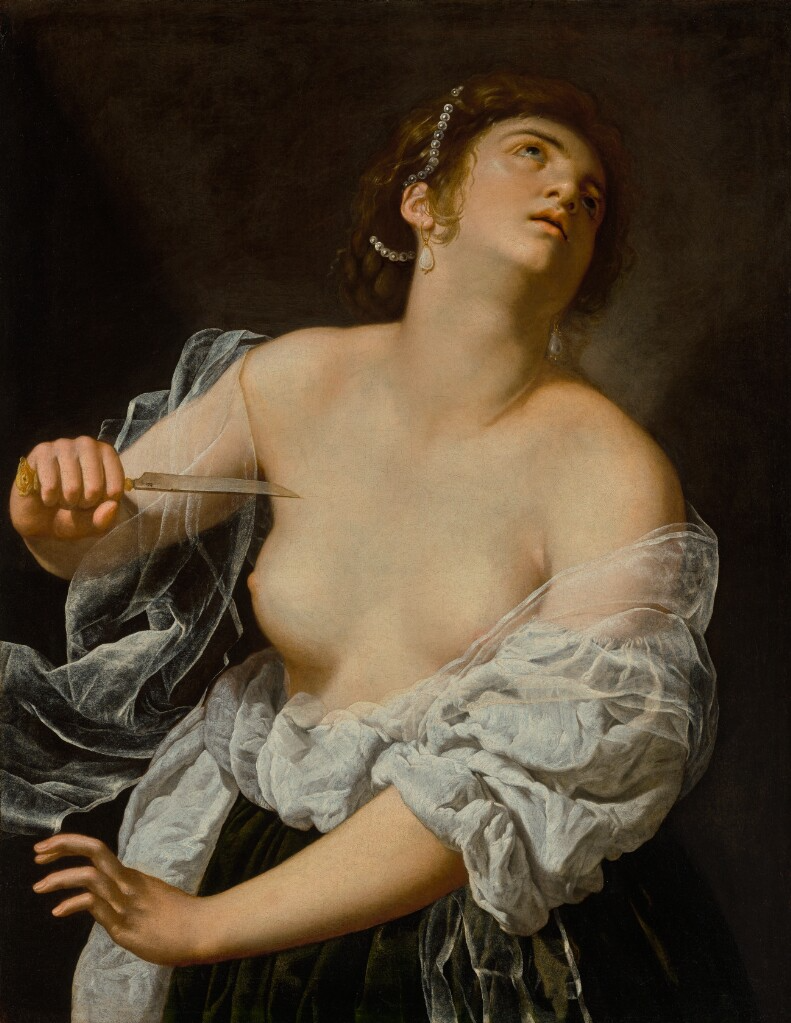
In the Getty Center in the Brentwood neighborhood of Los Angeles hangs a depiction of Lucretia painted by Italian Baroque painter Artemisia Gentileschi sometime around 1627.1.Artemisia Gentileschi, Lucretia, c. 1627, oil on canvas, 92.9 × 72.7 cm, Getty Center, https://www.getty.edu/art/collection/object/109Q8G [https://perma.cc/BT2Q-VJQR].Show MoreAs depicted by Gentileschi, Lucretia is obviously a noblewoman of some sort. She wears pearls not just as earrings but strung throughout her hair. Her shoulders are draped in a diaphanous, light white fabric that appears to be tulle. She gazes to the upper right corner of the frame with a plaintive look on her face. In her right hand, she holds a dagger with a silver blade. The end of the dagger’s hilt appears to be gold, ending in the small figure of an animal, maybe a rabbit. She points the dagger to her chest. According to legend, Lucretia, the faithful wife of Lucius Tarquinius Collatinus, was raped by Sextus Tarquinius, the son of the King of Rome.2.Lucretia, Getty, https://www.getty.edu/art/collection/object/109Q8G [https://perma.cc/BT‌2Q-VJQR] (last visited Nov. 11, 2024).Show MoreBefore stabbing herself to death, she “called on her father and her husband [to exact] vengeance” for this wrong.3.Id.Show MoreThe legend goes that anger over Lucretia’s death led to the fall of the Roman monarchy and the establishment of the Roman Republic.4.Virginia Gorlinski, Lucretia, Encyc. Britannica, https://www.britannica.com/topic/Lucreti‌a-ancient-Roman-heroine [https://perma.cc/TJE9-VXGN] (last visited Nov. 11, 2024).Show More

Artemisia Gentileschi, Lucretia (c. 1627)

A painting of a person holding a knife

AI-generated content may be incorrect.

There have been many depictions of Lucretia over many hundreds of years.5.See Natasha H. Arora, Lucretia’s Many Bodies Through the Ages, Art & Object (Dec. 15, 2022), https://www.artandobject.com/news/lucretias-many-bodies-through-ages [https://per‌ma.cc/BS2X-LKTW] (discussing various artistic depictions of Lucretia).Show MoreYet this depiction of her by Gentileschi is the one that I, as a rape victim, have always found most relatable. It focuses exclusively on Lucretia and her anguish rather than on the political ramifications of her death. Perhaps this empathy with Lucretia’s plight makes sense on the part of the artist, given that Gentileschi was raped by the artist Agostino Tassi when she was seventeen.6.Mary O’Neill, Artemisia’s Moment, Smithsonian Mag. (May 2002), https://www.smithso‌nianmag.com/arts-culture/artemisias-moment-62150147/ [https://perma.cc/H6B8-GQRV].Show MoreWhile Tassi initially promised to marry Gentileschi, he later refused, leading Gentileschi to report what happened to her father, Orazio.7.Joseph Wm. Slap, Artemisia Gentileschi: Further Notes, 42 Am. Imago 335, 337 (1985).Show MoreAt the time, “rape was viewed more as a crime against a family’s honor than as a violation of a woman,” and it was Orazio, rather than Gentileschi herself, who pressed charges against Tassi.8.O’Neill, supra note 6.Show MoreThe trial took more than half a year.9.Elizabeth S. Cohen, The Trials of Artemisia Gentileschi: A Rape as History, 31 Sixteenth Century J.47, 49 (2000). This does not mean, however, that it was a trial in the sense with which we would be familiar today. Rather, “[t]he trial dragged on through seven months of intermittent interrogations and legal maneuvers. During at least the first six weeks, there continued private negotiations toward a settlement ending in marriage.” Id.Show MoreGentileschi testified at the trial while tortured, purportedly to assure the truthfulness of her testimony.10 10.O’Neill, supra note 6.Show MoreAs she was put to thumbscrews, she exclaimed to Tassi, “This is the ring you give me, and these are your promises[!]”11 11.Slap, supra note 7, at 337 (quoting Rudolf Wittkower & Margot Wittkower, Born Under Saturn: The Character and Conduct of Artists 162 (1963)).Show More

Perhaps to today’s reader, both stories—Lucretia’s and Gentileschi’s—sound remote and archaic. There is, however, a long association between those attempting suicide and those reporting histories of sexual assault.12 12.Jonathan R.T. Davidson, Dana C. Hughes, Linda K. George & Dan G. Blazer, The Association of Sexual Assault and Attempted Suicide Within the Community, 53 Archives Gen. Psychiatry 550, 550 (1996).Show MoreBy one estimate, rape victims are 4.1 times more likely to contemplate suicide and are 13 times more likely to attempt suicide compared to non-victims.13 13.Dean G. Kilpatrick, Christine N. Edmunds & Anne Seymour, Nat’l Victim Ctr. & Crime Victims Rsch. & Treatment Ctr., Rape in America: A Report to the Nation 7 (1992).Show MoreMoreover, while victims no longer face physical torture at trial, they may still be tormented in other ways. For example, if victims do not want to testify, they can be threatened with jail time until they do.14 14.See Sexual Assault Kit Initiative & RTI Int’l, “Next-Level” Compulsion of Victim Testimony in Crimes of Sexual Violence Against Adults: Prosecutorial Considerations Before Using Bench Warrants/Body Attachments and Material Witness Warrants 2–3 (2022), https://sakitta.org/toolkit/docs/14451SAKINextLevelComplsnVctmTstmny.pdf [https://perm‌a.cc/T5ZT-Z8JR] (discussing the challenges victims of sexual assault may face if held in contempt for not complying with an order to testify).Show MoreThose that do testify risk being discredited or degraded and may have their experiences essentialized.15 15.See infra Part II.Show More

Victims of sexual assault continue to be shamed in a multitude of ways today. This Article introduces a typology of shame to consider when thinking about how victims are treated by the legal system and subjected to shaming through those mechanisms: the shame that victims feel or are made to feel by both investigations and proceedings in court, the shame that victims are supposed to perform for others, and the shame that victims are supposed to feel.

The title of my previous article addressing the language used by judges during sentencing in sexual assault cases is “Ruined.”16 16.Maybell Romero, “Ruined,” 111 Geo. L.J. 237 (2022).Show MoreThe reason there are quotation marks around that title is the basis for the argument of the paper itself; while judges may wish to pronounce rape victims “ruined,” it is the victims themselves who should be allowed to determine and pronounce their own fate.17 17.See generally id. (arguing that a judge’s pronouncement of a victim as “ruined” is stigmatizing and perpetuates myths about victimhood).Show MoreBut with the title of this paper, Shamed, I dispense with those quotation marks, not because victims should be ashamed of the harm that has been done to them, but because attempts to shame victims are real. They are pervasive. And they are harmful, even when such attempts are not immediately apparent. Shaming of sexual assault victims exists in police investigations, courtrooms, interpersonal relationships, and even within written laws. Not only have I been shamed, but I have shamed others in the course of prosecuting sexual assault cases. As Robert Cover has explained, “interpretive act[s]” on the part of judges are themselves “violent deed[s]” that both “authorize[] and legitim[ize]” acts of violence.18 18.See Robert M. Cover, Violence and the Word, 95 Yale L.J. 1601, 1614 (1986).Show MoreLegal interpretation “depends upon the social practice of violence” to be effective.19 19.Id. at 1613.Show More

This Article considers the existence of shame and its operationalization in the law in relation to rape and sexual assault. Shame itself is its own social sanction, and shaming is its own social practice. While judges and perhaps prosecutors attempt to use shame against sexual offenders as a legal sanction, shame is, primarily, a social sanction. Shame itself is about enforcing social norms, and so many of those norms enshrined in the law and larger culture are harmful and regressive when it comes to sexual assault.

I intend to consider shame—the concept and its operation—more closely in this Article at different junctures in the law and in society than I considered in “Ruined.” While other scholarship has also examined shame as well as shaming sanctions, this Article is unique in relating many of my own experiences of being shamed and wielding shame as a child, as a young female prosecutor, and especially, as a law professor and legal scholar. From this perspective, I also examine different forms of sexual assault shaming in legal professional spheres.

At multiple prosecution trainings early in my career, I and everyone else in the audience were informed that people (usually, specifically women) who have gone through sexual assault should never work on sexual assault cases because they would be too “biased” and would lack the objectivity to do the job well—that somehow victims of sexual assault would be overtaken by their emotions to the point of rendering them ineffective.20 20.When using the word “ineffective,” I mean it in a much more general sense, rather than as a specific reference to ineffective assistance of counsel as discussed in Strickland v. Washington, 466 U.S. 668 (1984), and its progeny.Show MoreIn an environment like that one, I certainly did not feel free to come forward with my story for fear that colleagues, law enforcement officers with whom I had to work, and maybe even other victims would judge me as not professionally competent to work on rape and sexual assault cases. When Kim Foxx, former Cook County, Illinois, State’s Attorney (the equivalent office of an elected District Attorney), came forward as a victim of child sexual abuse21 21.Carol Felsenthal, Kim Foxx Wants to Tell You a Story, Chi. Mag. (Dec. 10, 2018, 12:22 PM), https://www.chicagomag.com/chicago-magazine/january-2019/kim-foxx-wants-t‌o-tell-you-a-story/ [https://perma.cc/ZGE7-JDKH].Show Moreand rape as a college student,22 22.Carol Thompson & Dorothy Tucker, Kim Foxx Calls Findings Showing as Many as 1 in 3 Black Women in 2022 Were Victims of Crime “Jarring,” CBS News (Dec. 4, 2023, 10:27 PM), https://www.cbsnews.com/chicago/news/kimberly-foxx-findings-black-women-c‌rime-jarring/ [https://perma.cc/V25P-JVH2].Show More her objectivity and professional competency were privately questioned in a way unlikely to have happened if she had been the victim of a less stigmatized crime like burglary. Coming forward as a victim of sexual assault seems to flout many long-established trappings of respectability in the legal profession.

I have also experienced this professional shaming to some extent after writing, publishing, and presenting my recent article, “Ruined.” While the vast majority of the feedback that I have received has been encouraging and substantive, some of it has been very similar to what I heard as a prosecutor working on sexual assault cases. For example, I have had people praise my article, then abruptly ask if it was embarrassing to have it appear online or in print. I had a fellow law professor at a regional workshop critique the work on grounds that he felt he could not critique it at all, contending that I had rendered my arguments unassailable from normal inquiry because I had shared my story. In that sense, he performed a very similar maneuver to that which I heard in prosecution trainings and to that which Kim Foxx has faced—arguing that my experience has somehow rendered me unable to do my job well or even properly, and that it might have been better if I had never talked about it at all. Yet another couple of professors have told me that they refused to read the piece because they found the premise of another law professor sharing such a story too “uncomfortable.”

Law professors do not like being uncomfortable. Sure, they may enjoy being intellectually challenged; they may even enjoy arguing with each other over philosophical differences, interpretive differences, or ideological conflicts generally. Some of us may even enjoy debating the nature of legal scholarship—what it is, what it can be, and what it should be. But we do not like being uncomfortable, which is how I think much of my recent scholarship makes people feel. It is not meant to be enjoyable or easy, but rather to embrace the tradition of Martha Fineman and her approach to having “uncomfortable conversations.”23 23.Martha Albertson Fineman, Introduction: Feminist and Queer Legal Theory, in Feminist and Queer Legal Theory: Intimate Encounters, Uncomfortable Conversations 1, 1 (Martha Albertson Fineman, Jack E. Jackson & Adam P. Romero eds., 2009).Show MoreThis is the sort of discomfort that has led some law professors to stop teaching rape and sexual assault law in their first-year criminal law courses.24 24.Jeannie Suk Gersen, The Trouble with Teaching Rape Law, New Yorker (Dec. 15, 2014), https://www.newyorker.com/news/news-desk/trouble-teaching-rape-law.Show MoreThese uncomfortable conversations, however, need to be had, and I think by not having them, we do our students, the legal profession, and even ourselves a great disservice.

Part I of this Article starts by defining (or attempting to define) shame while distinguishing it from the related concept of stigma. It answers questions regarding why people engage in shaming victims, specifically those who have been raped or sexually assaulted. It also presents historical examples of shaming to demonstrate that the shame that is heaped upon victims today is of a long historical, cultural, and legal lineage. Not only does Part I explore examples of this shaming in the law, but it also offers a sampling of examples from literature, art, and popular culture to show just how pervasive this phenomenon is. Part II examines current ways that victims are shamed specifically by the criminal legal system, introducing a typology of shame and shaming that is the first of its kind in legal scholarship. Part III examines shaming in professional settings, particularly in the legal profession and in legal academia. It reflects on my experiences writing and publishing “Ruined” and scrutinizes what certain pedagogical choices in the criminal law classroom communicate to students. In that sense, it looks at shame in the larger legal and law school cultural environment. The Article closes by advocating for having the uncomfortable conversations that can push back against the shaming with which I and this Article take issue.

  1.  Artemisia Gentileschi, Lucretia, c. 1627, oil on canvas, 92.9 × 72.7 cm, Getty Center, https://www.getty.edu/art/collection/object/109Q8G [https://perma.cc/BT2Q-VJQR].
  2.  Lucretia, Getty, https://www.getty.edu/art/collection/object/109Q8G [https://perma.cc/BT‌2Q-VJQR] (last visited Nov. 11, 2024).
  3.  Id.
  4.  Virginia Gorlinski, Lucretia, Encyc. Britannica, https://www.britannica.com/topic/Lucreti‌a-ancient-Roman-heroine [https://perma.cc/TJE9-VXGN] (last visited Nov. 11, 2024).
  5.  See Natasha H. Arora, Lucretia’s Many Bodies Through the Ages, Art & Object (Dec. 15, 2022), https://www.artandobject.com/news/lucretias-many-bodies-through-ages [https://per‌ma.cc/BS2X-LKTW] (discussing various artistic depictions of Lucretia).
  6.  Mary O’Neill, Artemisia’s Moment, Smithsonian Mag. (May 2002), https://www.smithso‌nianmag.com/arts-culture/artemisias-moment-62150147/ [https://perma.cc/H6B8-GQRV].
  7.  Joseph Wm. Slap, Artemisia Gentileschi: Further Notes, 42 Am. Imago 335, 337 (1985).
  8.  O’Neill, supra note 6.
  9.  Elizabeth S. Cohen, The Trials of Artemisia Gentileschi: A Rape as History, 31 Sixteenth Century
    J.

    47, 49 (2000). This does not mean, however, that it was a trial in the sense with which we would be familiar today. Rather, “[t]he trial dragged on through seven months of intermittent interrogations and legal maneuvers. During at least the first six weeks, there continued private negotiations toward a settlement ending in marriage.” Id.

  10.  O’Neill, supra note 6.
  11.  Slap, supra note 7, at 337 (quoting Rudolf Wittkower & Margot Wittkower, Born Under Saturn: The Character and Conduct of Artists 162 (1963)).
  12.  Jonathan R.T. Davidson, Dana C. Hughes, Linda K. George & Dan G. Blazer, The Association of Sexual Assault and Attempted Suicide Within the Community, 53 Archives Gen. Psychiatry 550, 550 (1996).
  13.  Dean G. Kilpatrick, Christine N. Edmunds & Anne Seymour, Nat’l Victim Ctr. & Crime Victims Rsch. & Treatment Ctr., Rape in America: A Report to the Nation 7 (1992).
  14.  See Sexual Assault Kit Initiative & RTI Int’l, “Next-Level” Compulsion of Victim Testimony in Crimes of Sexual Violence Against Adults: Prosecutorial Considerations Before Using Bench Warrants/Body Attachments and Material Witness Warrants 2–3 (2022), https://sakitta.org/toolkit/docs/14451SAKINextLevelComplsnVctmTstmny.pdf [https://perm‌a.cc/T5ZT-Z8JR] (discussing the challenges victims of sexual assault may face if held in contempt for not complying with an order to testify).
  15.  See infra Part II.
  16.  Maybell Romero, “Ruined,” 111 Geo. L.J. 237 (2022).
  17.  See generally id. (arguing that a judge’s pronouncement of a victim as “ruined” is stigmatizing and perpetuates myths about victimhood).
  18.  See Robert M. Cover, Violence and the Word, 95 Yale L.J. 1601, 1614 (1986).
  19.  Id. at 1613.
  20.  When using the word “ineffective,” I mean it in a much more general sense, rather than as a specific reference to ineffective assistance of counsel as discussed in Strickland v. Washington, 466 U.S. 668 (1984), and its progeny.
  21.  Carol Felsenthal, Kim Foxx Wants to Tell You a Story, Chi. Mag. (Dec. 10, 2018, 12:22 PM), https://www.chicagomag.com/chicago-magazine/january-2019/kim-foxx-wants-t‌o-tell-you-a-story/ [https://perma.cc/ZGE7-JDKH].
  22.  Carol Thompson & Dorothy Tucker, Kim Foxx Calls Findings Showing as Many as 1 in 3 Black Women in 2022 Were Victims of Crime “Jarring,” CBS News (Dec. 4, 2023, 10:27 PM), https://www.cbsnews.com/chicago/news/kimberly-foxx-findings-black-women-c‌rime-jarring/ [https://perma.cc/V25P-JVH2].
  23.  Martha Albertson Fineman, Introduction: Feminist and Queer Legal Theory, in Feminist and Queer Legal Theory: Intimate Encounters, Uncomfortable Conversations 1, 1 (Martha Albertson Fineman, Jack E. Jackson & Adam P. Romero eds., 2009).
  24.  Jeannie Suk Gersen, The Trouble with Teaching Rape Law, New Yorker (Dec. 15, 2014), https://www.newyorker.com/news/news-desk/trouble-teaching-rape-law.